
The court in the William Keane case against Top Rank Boxing denied the promotion’s attempt to dismiss the lawsuit prior to responding to the merits.
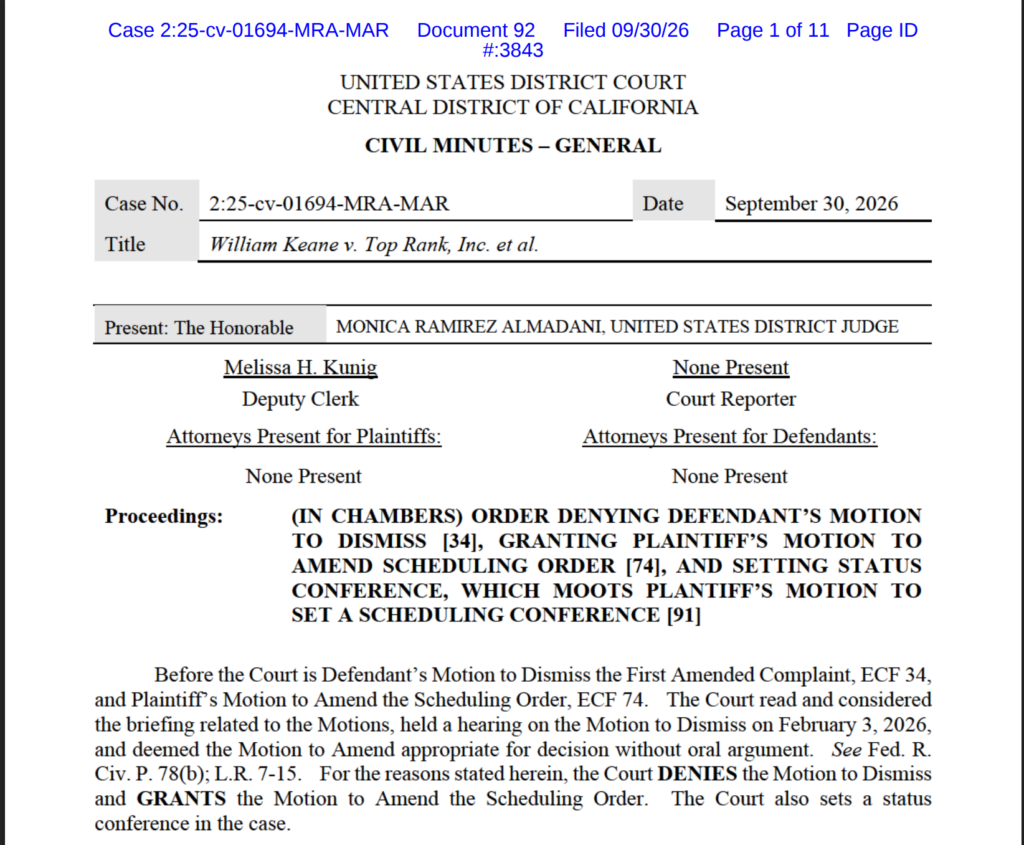
The lawsuit was first filed in 2015. There will be a status conference on October 13th to set pre-trial dates and deadlines. The court also heard Keane’s motion to reopen fact discovery to which the court found “good cause to reopen discovery for a limited time and purpose.” This is based on information obtained during the depositions of Bob Arum and Todd duBoef. Those depositions took place near the end of the non-expert discovery deadline. The Court cited the fact that no trial date had been set and Defendants would not be unduly prejudiced.
If you recall this lawsuit (FOS posted here and subsequent FAC I posted), Keane filed the lawsuit against Top Rank and Todd duBoef claiming Breach of Contract, Fraud and more as the promotion’s “fixer” or “recruiter” he claimed he agreed to a percentage of money (10%) of the fighter’s earnings he recruited for the company. An agreement was entered into in 2018 but not written down. In 2019, duBoef approached Keane and “requested a renegotiation of the 2018 agreement.” Keane had recruited a “high-profile fighter to Top Rank” but duBoef/Top Rank could not pay him the 10% fee. He offered 5% share for the fighter and for all future fighters stating that if he accepted the lower share he’d be Top Rank’s only in-house recruiter. Despite it being lower, duBoef allegedly sold Keane on the fact he’d be the only recruiter at Top Rank and all business would be funneled to him. Keane claimed that if Top Rank did not fulfill this new arrangement, Keane’s original 10% would be back in place. When Top Rank did not pay Keane the agreed to share, he was upset and this lawsuit was the result.
Defendants argued the “Economic Loss Rule” bars Keane’s claim of promissory fraud. The Economic Loss Rule states that you cannot recover tort damages where it should be covered in contract. However, the court reasoned, “Where a defendant uses promissory fraud to induce a plaintiff to enter a new or modified contract, the fraudulent inducement exception to the economic loss rule applies. “[t]he Court concluded that Defendants’ statement that “Keane’s fee would revert to 10% if Top Rank failed to timely pay him his 5% commission” was not an actionable misrepresentation under his claim, as it was not “Independent from defendants’ non-performance of the contract.” But, the court points out “Plaintiff could possibly add more facts to state actionable misrepresentations pertaining to Top Rank allegedly promising Keane would be its “primary” recruiter.”
The court pointed to allegations in Keane’s First Amended Complaint that he was being led along by duBoef. The court pointed out specifics as to Keane being informed that Bruce Trampler would work him on recruiting but was further led astray until he found out from Trampler that duBoef (allegedly) never directed him to work with Keane.
The court also found sufficient facts for Keane’s Breach of the Implied Covenant of Good Faith Claim. While the court previously dismissed it in the original complaint, the First Amended Complaint alleges that Top Rank and duBoef breached the 2019 agreement in bad faith, by undertaking conscious and deliberate acts to deprive Plaintiffs of the benefits of the agreement, then the claim survives. The court points to a specific allegation by Keane in which duBoef requested Keane’s “active and full time efforts” in recruiting [Tyson] Fury for three fights outside of the United States yet later took “the position for the first time following such fights that any fight outside the U.S. did not give rise to any payment obligation to Keane.” In the light most favorable to the plaintiff, the standard for a motion to dismiss, these additional facts support a breach of the implied covenant of good faith claim.
Payout Perspective:
Despite the detailed, granular information, it is an interesting case of an alleged arrangement that went array. Keane merely survived dismissal of claims and still must prove them. Keane’s attorneys are relying on the fact discovery will reveal evidence that an agreement was in place. On its face, without further discovery, Keane’s claims would have been hard to prove. But, at this point, this is promising for Keane. MPO will continue to follow.
Leave a Reply