
Lawyers for Jai Opetaia filed an opposition to the International Boxing Federation’s Motion to Dismiss. The boxer, who has two fights under his belt with Zuffa Boxing, protests the IBF for stripping him of his title.
Opetaia filed the lawsuit in July claiming that the IBF unfairly stripped him of his title this past March upon his debut fighting for Zuffa Boxing. The IBF responded to the lawsuit by filing a Motion to Dismiss.
Specifically, the IBF noted that Opetaia did not follow the IBF’s Appeal Procedure. The IBF argues that the dispute by Opetaia is not grounded in law but in the interpretation of IBF rules. As a result, the issue lies within the rules of the IBF and should be addressed as such.
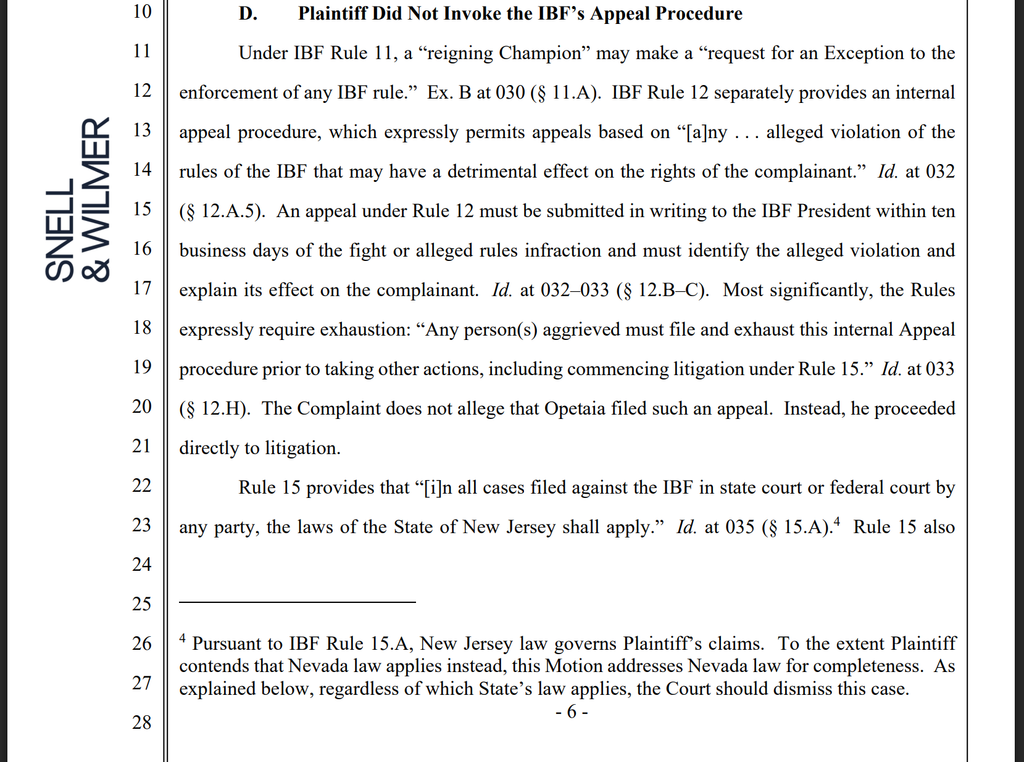
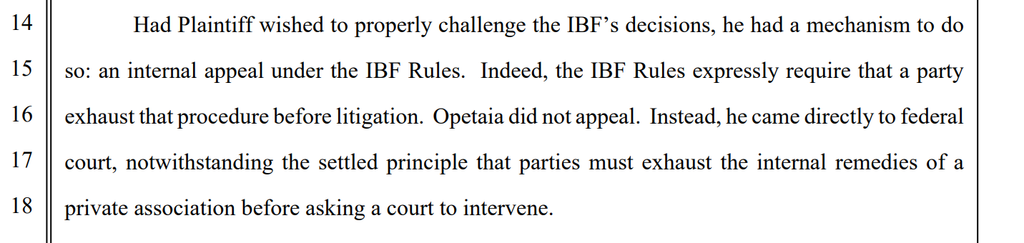
In its opposition brief, Opetaia argues that the “Exhaustion Doctrine” does not bar its claims related to misrepresentations and promises that are not a part of the rules.
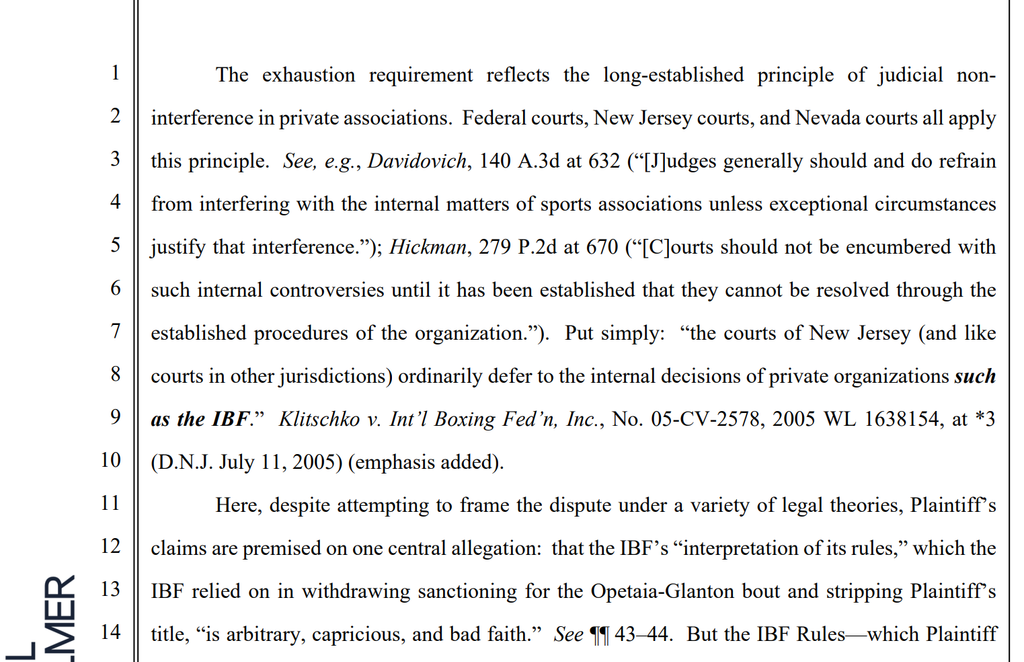
Notably, Opetaia discusses the two cases the IBF brought up in its motion. Notably, the Mahmoud Charr case against Don King was highlighted. The IBF noted that Charr’s claims were dismissed. Opetaia’s lawyers argue that the Charr case differs from Opetaia. “Unlike Jai’s case, Charr did not involve any claims unrelated to the sanctioning body’s rules. The boxer in Charr conceded his claims were rules-based but he failed to exhaust internal remedies under the rules.”
The distinction made by Opetaia’s lawyers is that the legal wrongdoing claimed by Opetaia does not relate to the IBF rules.
It also addresses the Wladimir Klitschko-IBF lawsuit from 2005 in which Klitschko sued to install himself as the mandatory challenger for the title. Opetaia argues that Klitscko’s claims arose out of IBF rules. “Each claim was predicated on allegations that IBF disregarded or misapplied the rules criteria for determining the next challenger.”
The court dismissed Kilitschko’s challenge.
Opetaia’s lawyers attempt to make the distinction that his legal claims are unrelated to IBF rules:
“Rather, Jai’s claims are based on IBF’s earlier and independent initial representations and promises that IBF would sanction the bout even with the Zuffa Belt on the line. IBF’s rules are not the source of the legal duties that Jai alleges IBF breached. To resolve Jai’s claims, neither the Court nor the jury will need to determine whether the Zuffa Belt was actually a violation of IBF’s rules. It is enough that IBF represented that it would sanction the bout despite the Zuffa Belt
without disclosing that IBF never intended to sanction it and, later, broke its promise to sanction it.”
Instead, Opetaia points to another boxing case, Roccogiani v. World Boxing Council .
“Jai’s claims are more like the boxer’s claims in Rocchigiani v. World Boxing Council, Inc., 131 F. Supp. 2d 527 (S.D.N.Y. 2001) that were not subject to a sanctioning body’s internal review mechanism. After Roy Jones Jr. vacated the WBC’s title, Rocchigiani won it. Id. at 528. WBC declared Rocchigiani’s title as merely an “interim” title and then revoked it. Id. at 528-29. Rocchigiani sued. Id. at 529-30. WBC contended that Rocchigiani’s failure to exhaust his private administrative remedies was fatal to his claims. Id. at 531. The court disagreed. It held internal exhaustion was inapplicable because Rocchigiani “ma[de] no claims, in cause of action number one, with respect to his rights under the WBC Constitution or
rules” containing the exhaustion requirements. Id. at 532.”
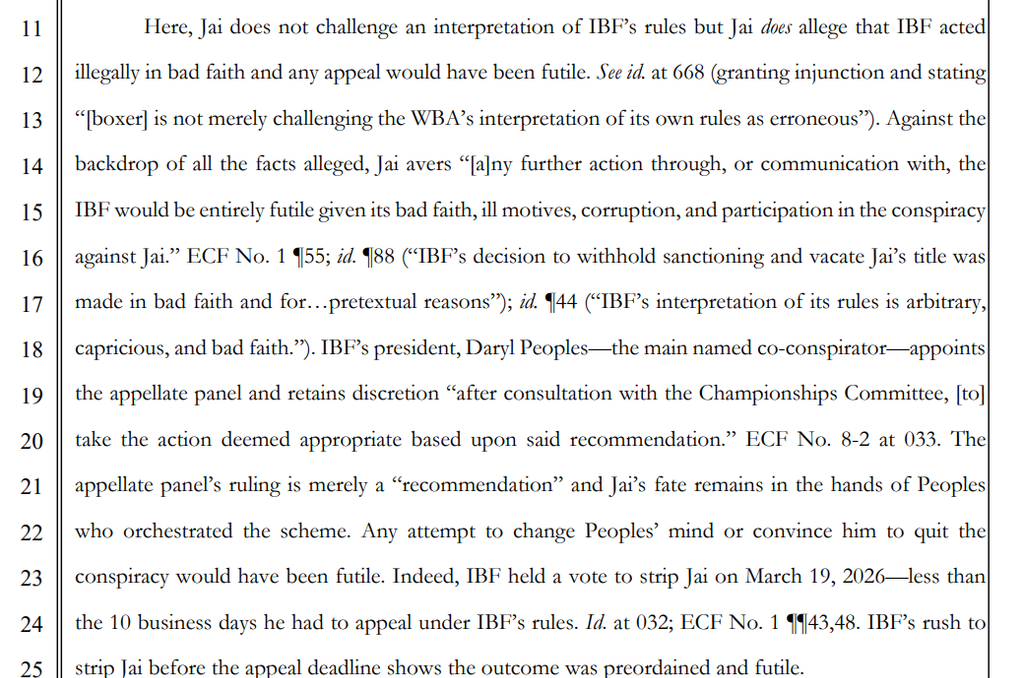
In addition, Opetaia asserts that even if the IBF rules apply, Opetaia appealed and/or was excused from going through the process noting an exception.
Payout Perspective:
Opetaia’s lawyers appear to concede its claim against the IBF for violation of the Muhammad Ali Act with respect to not making disclosures to the Nevada State Athletic Commission. However, it maintains that the rest of the lawsuit do not relate to specific items in the IBF rules. Boxing does have case law on this particular subject which will make it interesting to see how the Court will interpret previous rulings. Broken down, Opetaia’s claim is based on alleged misrepresentations made by the IBF. The big question is how can he prove his case, and does he have one.
Aside from the Ali Act clam, the rest of his allegations Fraud, Breach of Contract, Breach of Implied Covenant of Good Faith and Fair Dealing, Promissory Estoppel, Intentional Interference with Prospective Economic Advantage, Intentional Interference with Contract Relations, Aiding and Abetting and Conspiracy hinge on evidence that there is evidence that the IBF meant to withdraw its sanctioning of the fight at the last minute as a way to punish Jai for signing with Zuffa Boxing. This will be a hard threshold to show. MPO will continue to follow.
Leave a Reply