
The Muhammad Ali Boxing Reform Act was formally introduced into the Senate on Thursday. The Senate version is being sponsored by Ted Cruz (R-Texas) and Jacky Rosen (D-Nevada).
The Senate version has two distinct changes from the version that was lobbied to in the House. The changes will have to be reconciled with before a full vote.
The first change from the one that passed through Congress is that a fighter’s first contract with a UBO (“Universal Boxing Organization”). If a fighter has not signed a promotional agreement before in his pro career, his first will be a maximum of three years. After the first contract, fighters can sign deals for up to six years. They would be able to negotiate new deals up to 90 days before the expiration of any contract. The original bill introduced in the House would give fighters only 30 days.
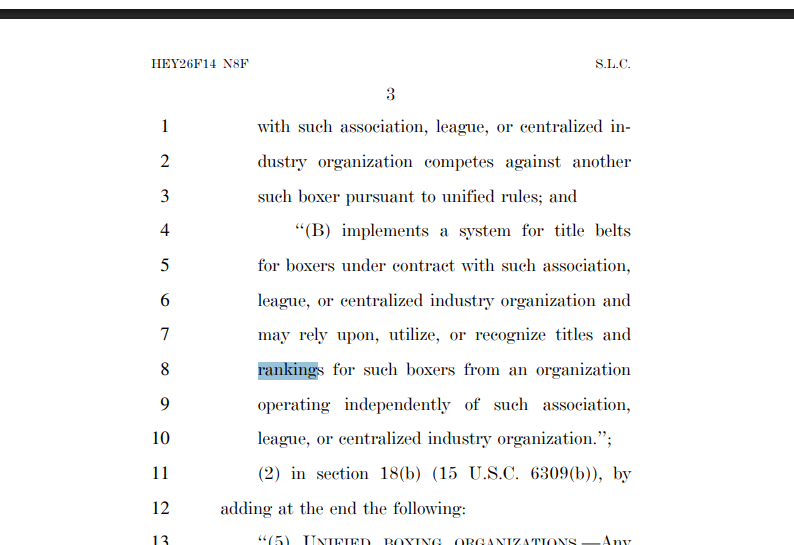
The second change is that the Senate bill removes a provision in the House bill consolidating boxing titles. The original bill that was submitted and voted on in Congress calls for one championship per weight class for each sanctioning body with an exception for interim titles. The Senate bill removes one title per weight class.
In addition, UBOs “may recognize rankings and titles, preserving opportunities for crossover fights an undisputed champions.”
Payout Perspective:
While the proposed law has been sold as a refresh of the current version of the Ali Act to update health and safety standards, the overarching issue is the business side of boxing. With this version of the reform bill, there are still ways in which UBOs can get around the moratorium of 3 year contracts to young prospects. Moreover, after the first contract, the limits extend to six years. Hence, a fighter could still be held in a contract that extends his whole career. Certainly, a UBO could sign a prospect to a one year deal and then extend him to a six year deal once his first contract is up.
Another issue is the elimination of the “singular title” language which was in the Congressional version. The Senate Bill eliminates that language and thus continues on with a problem of multiple belts across weight classes. And with the addition of the UBOs that may award their own belt, it creates a logjam of more belts in the weight divisions. With a lot of lobbying efforts on behalf of Zuffa Boxing, its clear that without Amendments to this proposed law, the industry may just be pounding sand. MPO will continue to follow.
Leave a Reply