
Zuffa prepared responses to queries by Minnesota Congresswoman’s Ilhan Omar with respect to a Congressional Subcommittee Hearing that occurred in December and a subsequent hearing held in January in which the subcommittee passed the bill to move on in the long process even prior to getting to a House vote.
There have been amendments made to the bill including a couple notable ones limiting boxing contract to 6 years and increasing the minimum pay of boxers per round from $150 to $200.
The written responses by Zuffa (presumably by Lawrence Epstein) relate to concerns she had with the Muhammad Ali American Boxing Revival Act during the hearings.
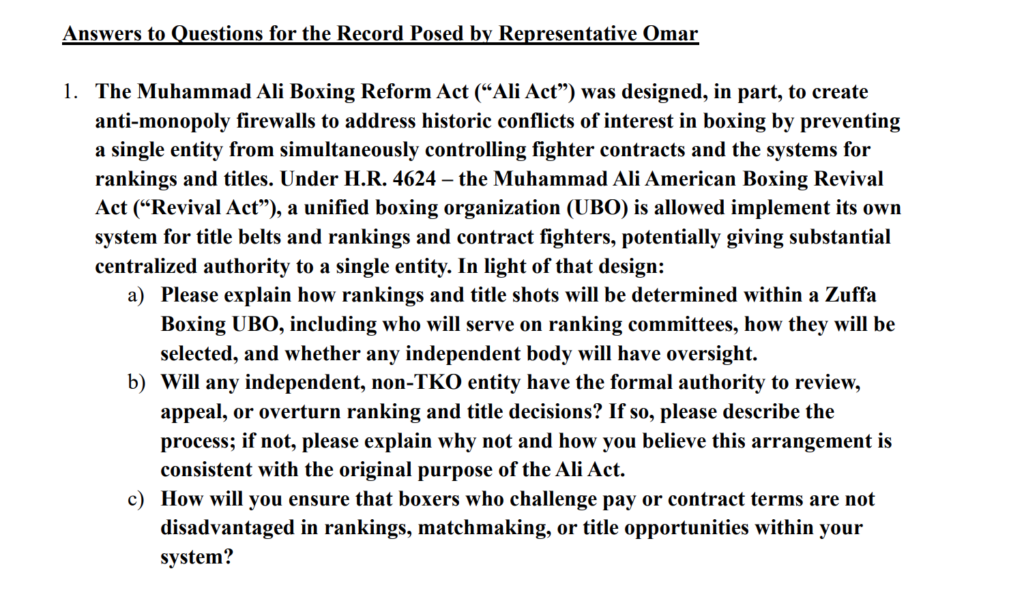
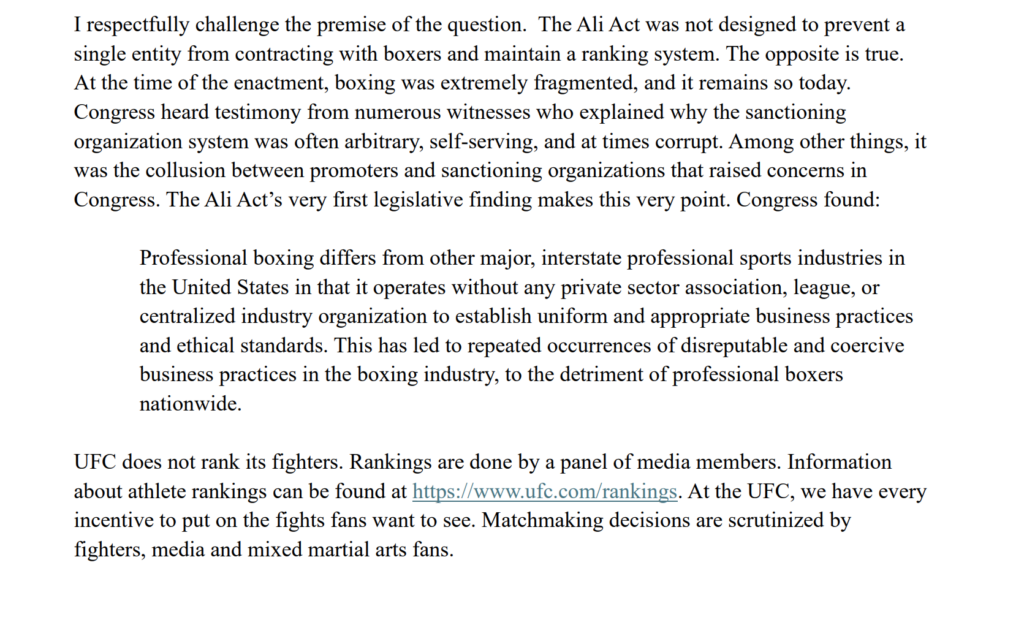
The response to the first question is a non answer because they believe the question makes assumptions about the current Muhammad Ali Boxing Reform Act, misstates the reason for the federal law and/or they just did not want to address the question. Instead, they promote the Revival Act by characterizing the current state of boxing “extremely fragmented.”
“Congress heard testimony from numerous witnesses who explained why the sanctioning organization system was often arbitrary, self-serving, and at times corrupt.”
According to the Ali Act, the purpose is to (1) Protect the rights and welfare of boxers; (2) Aid state boxing commissions with the oversight of boxing; (3) Increase sportsmanship and integrity within the boxing industry. Omar’s question builds on the purpose but is too specific so that Lawrence is able to provide a non-response rather than accept the premise.
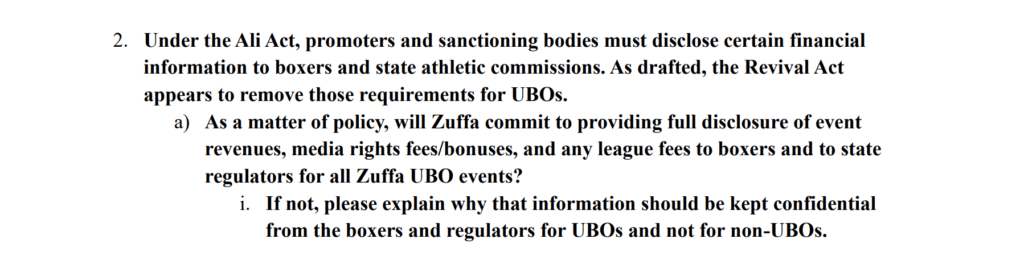
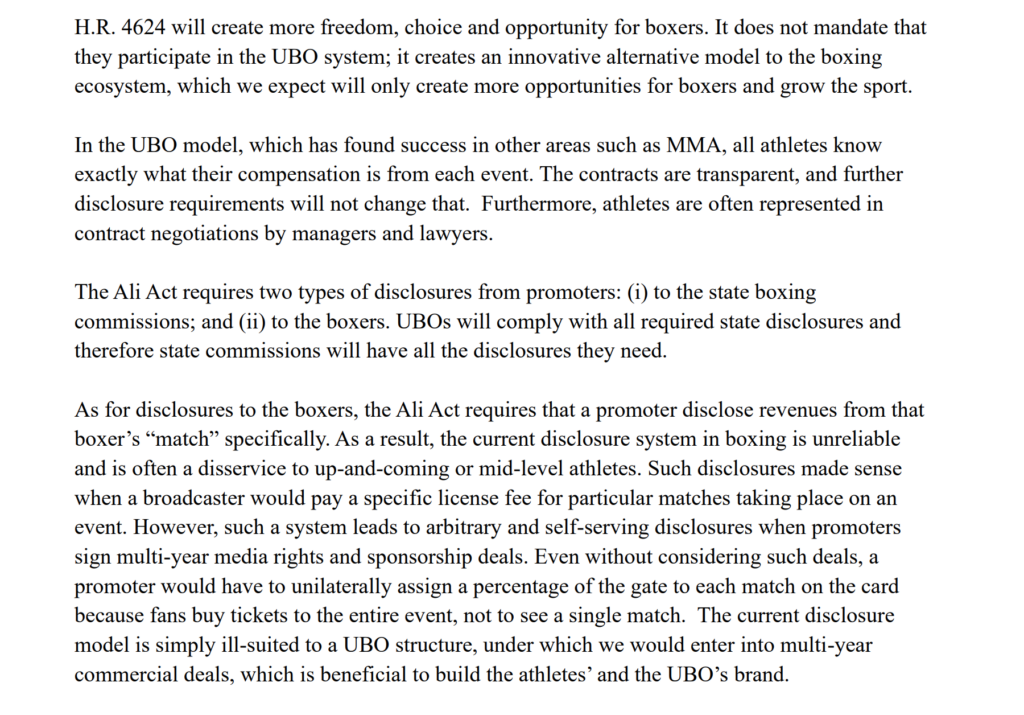
The second question poses an interesting question regarding disclosure requirements included in the current Ali Act. Certainly an issue as to how and when disclosure should occur. And, when and to whom it should be disclosed to is something that the current legislation is vague (in my opinion).
What is interesting in the response is that they infer that the “UBO” model has been successful. Really, where? Also, it uses the current Act’s vagueness (re disclosure) as a reason why the current system is “unreliable.”
There was a question about UBO’s and if Zuffa could predict how many there would be. Of course, Zuffa claims it would not know but cites the UFC’s has competition in the MMA market citing the PFL.
Probably a weak question by the Congresswoman and a weak answer from #Zuffa. The question is about the potential for other UBOs and the concern of a monopoly. Zuffa points to #UFC's competitor #PFL as an example pic.twitter.com/iDMfShcYAZ
— MMA Payout (@MMAPayout) February 13, 2026
Also of interest, a question poses the ownership and capital structure of Zuffa Boxing. But, Zuffa states that the information is confidential.

Maybe the most disingenuous response comes in question 7 where it is asked whether “Zuffa Boxing contracts allow boxers to participate in non-UBO bouts…
Read between the lines here. #Zuffa #Boxing will have exclusive contracts which would prevent a fighter under contract to participate in non-UBO bouts. HOWEVER, the specific Ali Revival Act does not necessarily say that. pic.twitter.com/108s2dx8nj
— MMA Payout (@MMAPayout) February 13, 2026
The proposed law would not preclude a UBO from allowing a fighter to participate in non-UBO fights. However, its almost a certainty that Zuffa Boxing would include an exclusivity clause which would preclude fighters from participating in non-UBO fights. Certainly, if a contracted fighter would participate in a non-UBO fight it would be considered a breach of contract which likely includes financial penalties. So, while Zuffa responded to the question truthfully, reading in between the lines would reveal that Zuffa Boxing’s UBO would not allow inter-promotional fights.
Payout Perspective:
What’s the most frustrating about the proposed law is that there can be so much done to protect fighters and update the Ali Act, but TKO is protecting its own business model and (through semantics) is marketing law as something that on its face looks like it will help boxers.
Leave a Reply