
Despite no longer working with Top Rank Boxing, a former attorney for the promotion found himself needing his own attorney to deal with lawyers deposing him in the William Keane case.
As a result, Harrison Whitman’s attorney claims that he had to spend over $53,000 to defend himself.
Its worthy to note that Whitman is the current Chief Operating Officer of Zuffa Boxing and also a part of Richard Schaefer’s Probellum promtion.
Whitman claims that he was subject to “a campaign of bullying and harassment.” He also argues that Top Rank failed to indemnify Whitman pursuant to his former contract with the company.
The filing points to Top Rank’s law firm, O’Melveny & Myers, LLP (“OMM”) as the source of much of the adversarial feelings leading up to the filing.
Whitman was an employee of Top Rank and then later an independent contractor for the company. His independent contractor agreement included a broad indemnification agreement according to the filing.
As a part of this lawsuit, he was contacted in 2025 to “request his cooperation with Top Rank’s defense, including conducting an interview.” As a part of his cooperation, Whitman stated that he needed his own legal counsel and “would need to be indemnified for his legal fees and expenses.” Top Rank declined paying for his legal fees.
OMM referred to a “Confidentiality and Restrictive Covenant Agreement” from October 2019 which stated that payment of severance was conditioned upon reasonably cooperating with Top Rank “as it may reasonably request…in connection with any litigation by or involving the Company.”
Whitman retained his own counsel to respond to OMM. They argued that the alleged contractual obligations for Whitman were false. Despite the response, OMM continued to assert potential legal action against Whitman if he did not assist in the Keane litigation. Notably, OMM claimed Whitman agreed to a specific deposition date, which he had not. Whitman’s attorneys claim that OMM made the assertion that if he did not testify on the side of Top Rank that he could be subject to litigation.
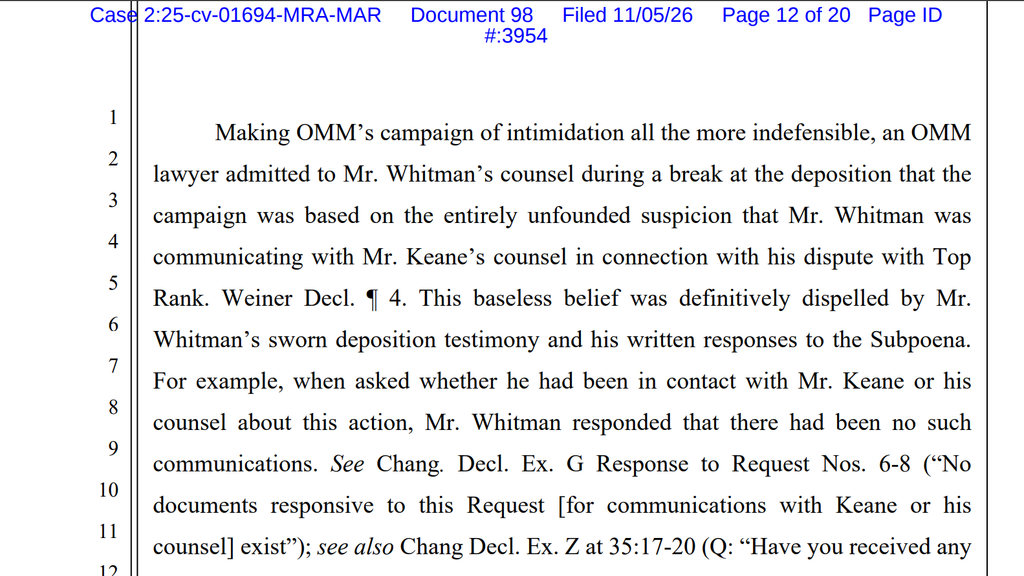
Notably, Whitman claims that OMM’s “campaign of intimidation” was done under the “unfounded suspicion” that Whitman was communicating with the plaintiff.
The motion argues that the deposition held by plaintiff and Top Rank and the accompanying requests for document production were for the benefit of the promotion’s case. Whitman claims that the rules suggest that he should not be forced to “bear the expense” of these litigation matters. The bigger issue which is the likely cause of the motion is that OMM’s denial of indemnity toward Whitman while threating him with potential litigation if he did not comply in its favor.
Payout Perspective:
There is likely more to this than what we have in this motion but it’s clear that either OMM knew Whitman would be a hostile witness or they did not believe that indemnifying Whitman of any wrongdoing was a prudent legal decision in this litigation. Still, having to hire your own lawyer in these circumstances are costly as well as unique as the former employer/contractor usually defends and indemnifies former employees that testify on behalf of the company. But, one might infer that the hostility toward Whitman means that he may not have been a complicit witness. MPO will continue to follow.
Leave a Reply