
The International Boxing Federation has filed a Motion to Stay Discovery in its case against boxer Jai Opetaia pending the results of the IBF’s motion to dismiss complaint. The motion was filed in response to 101 document requests from Opetaia’s lawyers.
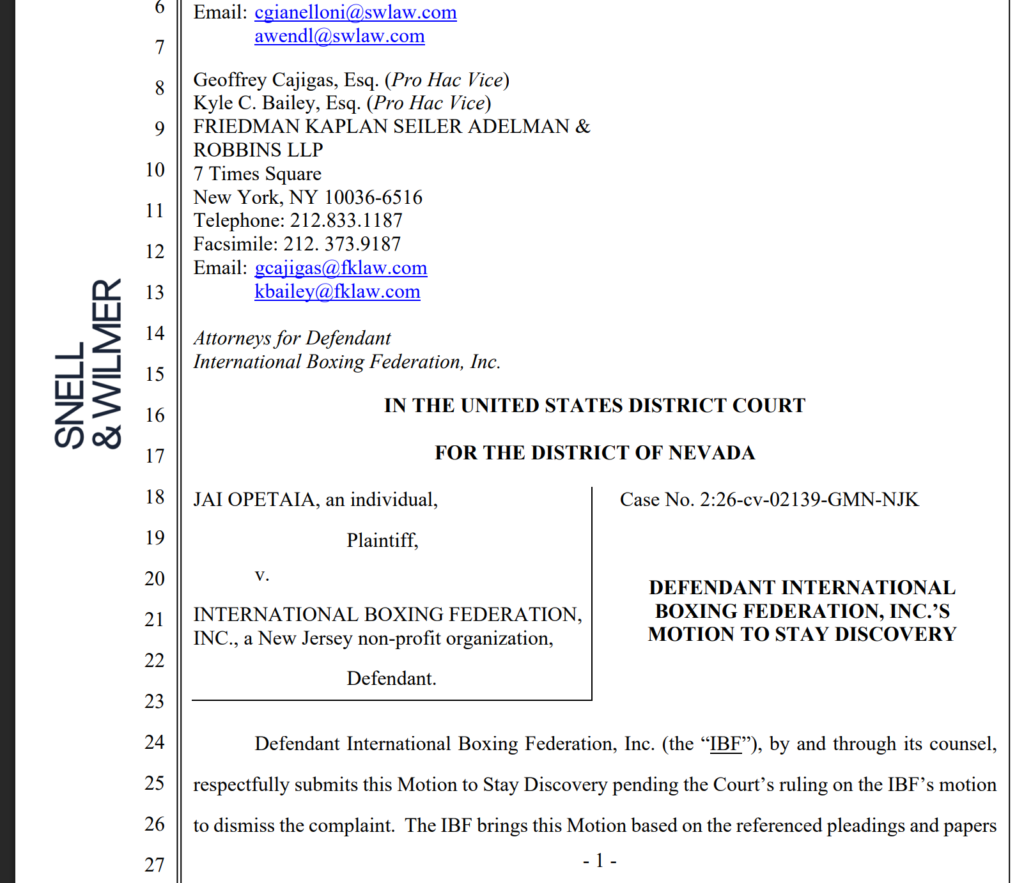
As a refresher, Opetaia filed the lawsuit in July alleging that the IBF pulled the sanctioning of his March Zuffa Boxing debut at the last minute. He was also stripped of the IBF cruiserweight title in light of fighting for Dana White’s promotion. The IBF filed a Motion to Dismiss the case.
In legal proceedings, the Motion to Dismiss precedes the defendant from responding to the Complaint. Defendant’s file a Motion to Dismiss because it believes the lawsuit has no merit. Here, the IBF claims that Opetaia’s lawsuit has no merit. As a result, it has filed the Motion to Dismiss.
The IBF claims that the one federal claim, the Muhammad Ali Boxing Reform Act is subject to dismissal for lack of Article III standing and for failing to show economic injury arising from the alleged claim. The other claims in Opetaia’s lawsuit were subject to the IBF rules which were not followed by the boxer prior to filing the lawsuit.
The IBF argues that the Court has “wide discretion in controlling discovery.” Court in the Ninth Circuit “take one of two approaches to determine whether staying discovery is warranted.” First is the “preliminary peek” framework showing “good cause to stay all discovery exists” when: the pending motion is potentially dispositive in scope and effect; the potentially dispositive motion can be decided without additional discovery; and the Court has taken a “preliminary peek” at the merits of the potentially dispositive motion and is convinced that the plaintiff will be unable to state a claim for relief. Second, the “good cause” approach, which is the test taken by less courts. In this scenario, there must be a showing “that discovery would be burdensome without consideration of the merits of the underlying disposiitve motion.
The IBF argues that the motion to stay satisfies either test.
Payout Perspective:
We can see that the IBF Motion to Stay Discovery in light of the Motion to Dismiss serves multiple purposes for its side. First, it is cost-effective determining the merits of the Motion prior to having to expend money to pay attorneys to dig into discovery and search for items. Moreover, whatever discovery is produced will likely not be enough from Opetaia’s side. Second, it puts some pressure on the Court to make a decision on the Motions (either one) to move the case forward. Third, it prevents Opetaia’s seeking information that may be used in future cases. Finally, it precludes the potential for any “red flag” documents to be found which may turn the case on its head.
Notably, the IBF claims that Opetaia uses a letter from Marc Ratner (Zuffa exec) as proof that the boxer did make an attempt to use IBF rules but found that it would have been fruitless. The IBF states that this information was not included in its lawsuit.
Opetaia will have a chance to file a response to the Motion and we will see how the Court will respond. While the IBF has some strong arguments for there not be discovery at this point, it seems like a Court will want to ensure that the plaintiff has had ample opportunity to litigate its case (in the oft hand case there is information found after the lawsuit is disposed of and another lawsuit is filed).
MPO will continue to follow.
Leave a Reply