
The parties in the ongoing lawsuits in the Mikhail Cirkunov lawsuits filed Joint Status Reports in preparation for a status conference heard before Judge Boulware last week. The status conference included a disputes over “discovery deficiencies” between the parties.
If you are familiar with big time lawsuits (or any civil lawsuit for that matter), there are always fights over discovery with one side asking for more and the other side saying they don’t have the information or that they’ve already provided it.
This is the case here. While this does not cover all the categories the parties are disputing, it should give you more than you need.
The parties conducted a “meet and confer” on November 4th to discuss the issues they had with discovery. The parties provided the Court with its respective opinions. Specifically, the plaintiffs are arguing that the defendants have not produced certain documents relevant to the respective cases. Since some of the documents have already been provided in the Le Antitrust Lawsuit, Plaintiffs are requesting an update of those documents. Defendants argue that the Cirkunov lawsuit should be limited in scope of discovery to just information related to the arbitrability of the contract signed by Cirkunov.
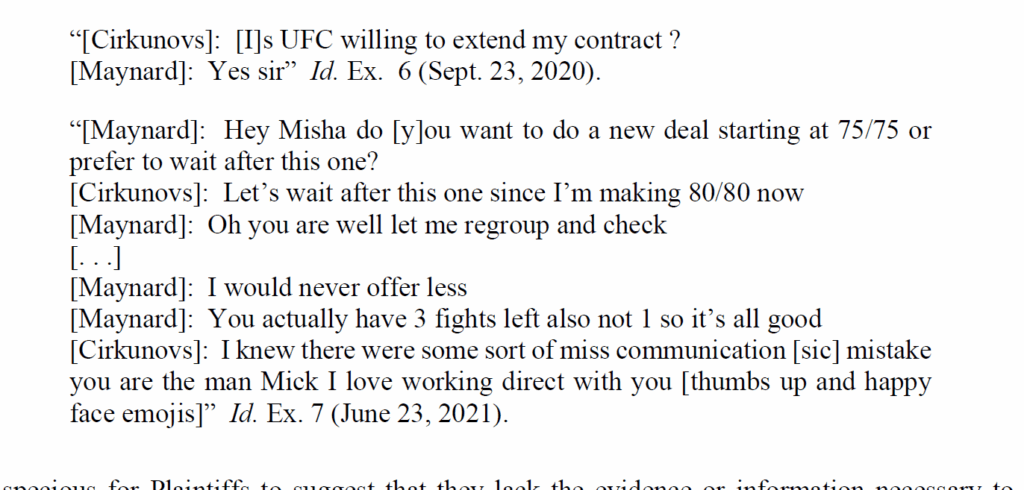
In its legal filing Defendants provide a text message exchange between Cirkunov and Mick Maynard which suggests that he was under contract.
The production of documents is electronic and entails a niche practice of the law of eDiscovery. In this lawsuit, one of the big issues the parties are arguing over are “hit reports.” A hit report is a document in e-discovery that shows the results and helps facilitates discovery by having the parties identifying key words to ensure that that each side making the request can find the key word. This helps expedite litigation and ensures that neither side is sandbagging the other by hiding documents. Of course, there is a fight over key words but once that is finalized, the parties have an opportunity to use the key word search to find the relevant portions.
Additionally, Plaintiffs assert the following:
Plaintiffs’ position
Plaintiffs also identify “shortcoming” in Defendants’ Trackers. Tracking involves monitoring data from its initial creation to its final disposition. In the context of eDiscovery, this means keeping a close eye on what data exists, where it is stored, and its relevance to a case.
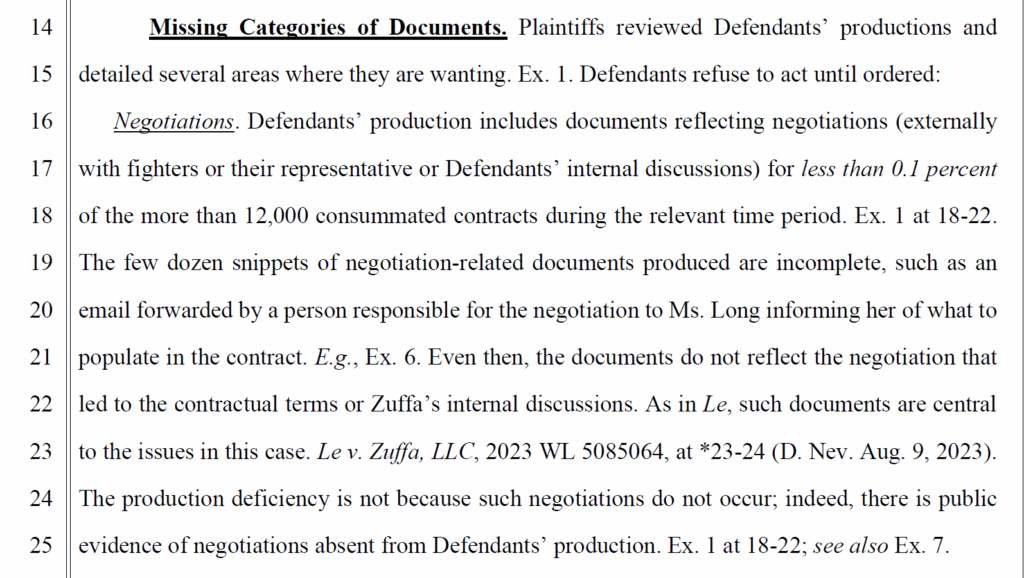
As indicated int he screenshot above, Defendants’ productions are missing categories. Notably, information on negotiations between fighters and the UFC are “incomplete” per Plaintiffs. “Defendants’ production includes documents reflecting negotiations (externally with fighters or their representative or Defendants’ internal discussions) for less than 0.1 percent of the more than 12,000 consummated contracts during the relevant time period. The few dozen snippets of negotiation-related documents produced are incomplete, such as an email forwarded by a person responsible for the negotiation to Ms. Long informing her of what to populate in the contract.” The inference here is that information is missing from the database of documents. Inferring from the inquiry, one infers that Plaintiffs are looking for negotiations between fighters and the parties which might give some context to the allegations of pay suppression which is an overarching theme in these antitrust lawsuits.
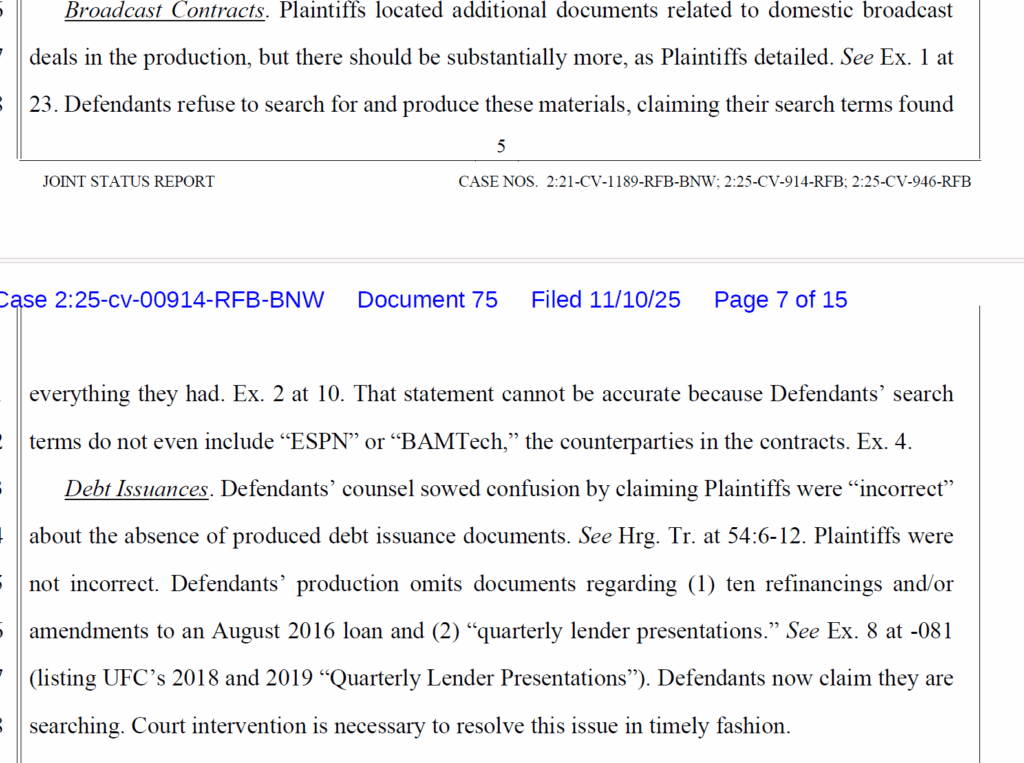
Plaintiffs note that they have not been able to find certain domestic broadcast deals to which they indicate Defendants “refuse to search for and produce…”
Another issue appears to be the spoilation of evidence. “Defendants appear to have produce no more than 244 text and chat communication for 13 custodians over a ten-year period. Defendants refuse to fully identify (voluntarily or in response to the Court’s Order) devices and the communication platforms and to produce relevant communications. Again, the text messages might include some indication that the Defendants may relate to Plaintiffs claims.
Defendants refute Plaintiffs’ assertions. They responded as follows:
Defendants argue that the discovery in the cases after Le are “cumulative and unduly burdensome” as the information was provided in the Le case.
Plaintiffs contend that Defendants’ productions are missing certain categories of documents, including (1) certain fighter compensation data, (2) debt issuance documents, and (3) July 1, 2015 – June 30, 2017 fighter promotion agreements (“PARs”). See Dkt. No. 253 at 4-5. The parties addressed each of these categories during the hearing before Judge Weksler on September 29, 2025 (see Dkt. No. 260 at 48:22-62:25). Defendants have since agreed to conduct targeted searches and produce certain responsive documents Plaintiffs point to in their October Letter, to the extent any exist
Defendants also dismiss the alleged missing text messages by stating: “While Defendants remain open to conducting a broader review of text messages, Plaintiffs still refuse to actually engage in Defendants’ offers to conduct a broader review informed by Defendants’ master trackers and October 13 mobile device disclosure, and instead request that Defendants conduct a linear review of all text messages.”
Similarly, in the Kajan Johnson case (and Cirkunov I think) the Plaintiffs are seeking fighter contracts but Defendants argue that they were already provided from Zuffa’s “central file.” Tracy Long, Zuffa’s Vice President of Athlete Compliance and Regulatory was in charge of fighter contract for the UFC. Already, over 130,000 documents have been collected from Long in discovery.
Hence, Defendants are telling the Plaintiffs to check the information already supplied.
Other odds and ends
Defendants inform the court that it provided information about mobile devices in October.
Despite Defendants’ attempt to engage with Plaintiffs, Plaintiffs continue their “my-way-or-the-highway” approach to discovery and refuse to accept Defendants’ invitation to begin to negotiate RFP-by-RFP search terms for Defendants’ documents. Instead, Plaintiffs continue to request that Defendants apply each of Plaintiffs’ 4,000-plus search terms across 63 custodians. Plaintiffs’ refusal to negotiate in good faith over Defendants’ offers to expand discovery—and then complain to the Court about alleged deficiencies—is just the latest example of Plaintiffs’ desire to create issues where none exist.
Super Custodians
Super Custodians is a term referred to in electronic discovery of individuals designated as administrators for modern collaboration platforms who can access, manage, and retrieve data across various users and locations. In this case, Defendants’ allege that Plaintiffs are requesting overbroad demands of them via a survey that they request they respond to in addition to the production.
Payout Perspective:
The Johnson, Cirkunov (and soon to come Davis) antitrust cases are starting to merge together. Not literally, but in terms of documents and what is relevant to each case. For the outsider, it is hard to tell the remaining 3 apart after Le. At this point, both Johnson and Cirkunov are having discovery disputes while there is a pending motion to dismiss in the Davis case. The discovery disputes are still being hashed out. Based on last week’s status conference in Cirkunov, it will go before a judicial magistrate to once again discuss the differences.
In my opinion, it comes down to a couple things inherent in litigation that has occurred in previous cases. Plaintiffs will always ask for as much as possible including updates on existing information that they may have. Defendants will say that Plaintiffs already have the information. Or, in the alternative, the information they seek does not exist. From the Plaintiffs side they want to ensure that they have captured all the information they need for there case and have exhausted every effort on behalf of their clients. Defendants want to make sure that they do not repeat or provide Plaintiffs with an extensive amount of information or the requests will never end. At some point they must shut off the spigot while ensuring that they provided the pertinent information. Thus, we have these long standoffs.
MPO will continue to follow.
Leave a Reply